

Abstract
In "Design did not show up for work today," Vinish Garg interrogates the hidden human costs of modern product development, asking: Why do well-intentioned organizations consistently produce products that cause unintended suffering, and have we forgotten to consider how our digital infrastructure actually makes people feel? Through a dialogue between an organization and its personified "Design," Garg posits that the root cause of this harm is not malice, but the underlying system itself. Driven by quarterly targets, engagement mechanics, and rigid hierarchies, this system possesses its own logic that individuals follow without actively choosing the negative outcomes it produces. He argues that organizations construct self-serving measurement systems to validate their success, conveniently ignoring the psychological nudges designed to trap users. By prioritizing the product backlog over human well-being, companies inadvertently create environments where teenagers cannot sit with their own thoughts and workers are bombarded with notifications when their psychological defenses are lowest.
The key takeaways emphasize that true design requires a profound re-engagement with human Empathy, moving beyond the sterile metrics of Organizational Ideology and addictive habit loops. We must study the visceral responses of the human body to our digital environments, recognizing that a seemingly insignificant red error message can signal to a vulnerable, anxious user that the world was not built with them in mind. To rectify this, organizations do not need to anticipate every possible emotional state; rather, they must hire and empower individuals who remember that they have one, ensuring that the infrastructure we have forgotten to see is brought back into the light of conscious, compassionate design.
#infrastructure #consequences #proximity
"Design did not show up for work today"
A conversation about infrastructure we've forgotten to see
Monday, 9:47 AM (Year, any)
Org: I noticed you're not in any of the meetings today.
Design: I'm thinking of something.
Org: Thinking what?
Design: How long it takes before someone notices I'm missing.
Org: That's... cryptic. Is this about the sprint? We can reschedule if…
Design: Do you remember when you started?
Org: Of course. We had an idea. We thought it would help people.
Design: Did it?
Org: We have three million users. Revenue growing thirty percent year on year. We've been…
Design: That's not what I asked.
Org: We think it helps people, yes. Our NPS score…
Design: You built a measurement system to tell you what you wanted to hear.
Org: That's not fair. We measure outcomes. We track retention…
People can leave if they want. We don't trap anyone.
Design: You designed an environment with twenty-seven nudges to prevent them from leaving, and then tell yourself they stayed by choice.
Org: You're being dramatic. We're a technology company, we don't set out to harm anyone.
That's how every product works. Engagement mechanics, habit loops. We are giving them value for their investment in our product.
Design: I know. I built them. That's what I want to talk about.
Peter Senge spent his career studying systems. He found something that should disturb you deeply.
Org: Which is?
Design: We consistently produce suffering that nobody intends.
Not because people are malicious. Because the system—the incentives, the hierarchy, the quarterly targets—has its own logic. And individuals inside it follow that logic without ever choosing the outcome it produces. (Reference to Peter Senge’s book)
Your people are good people. I believe that.
But the system you've built produces outcomes your good people would be horrified by, if they stopped long enough to see them.
Org: Then tell me what we're producing. Specifically.
Design: Specifically?
A generation of teenagers who cannot be alone with their thoughts for four minutes, because your algorithm has trained them to reach for their phones before the discomfort even registers.
Workers who check your productivity dashboard at nine o'clock at night because you designed the notification to arrive when their defenses are weakest and their anxiety is highest.
You produce these things.
Not because you wanted to.
Because you never thought about whether you should.
There is a person trying to sign in but you make them feel as if they are stupid. It means you have failed — before they have had the chance to fail.
Have you ever thought about how it feels at that moment?
Someone designed that.
Not maliciously. Probably in a rush. Probably without anyone in the room who said: wait — what does a person feel when they see red before they've done anything wrong?
Org: That's not a big deal.
Design: To you it might be a small thing.
To the person who just got locked out of their account at seven in the morning, who has a presentation in forty minutes, who is already running late, who is already nervous—the red text is one more signal that the world was not designed with them in mind.
It is small in your backlog.
It is not small in their body. I guess we need to study the human body when we talk about the influence of design.
Org: We cannot anticipate every emotional state. We cannot design for every emotional state.
Design: You do not need to anticipate every emotional state.
You need to hire people who remember they have one.
There is a job posting — a company hiring a UI/UX designer, asking for proficiency in Figma, Sketch, Adobe XD, Invasion. An autocorrect artifact. Nobody caught it. A company asking for design skill, displaying the absence of it in the hiring post itself.
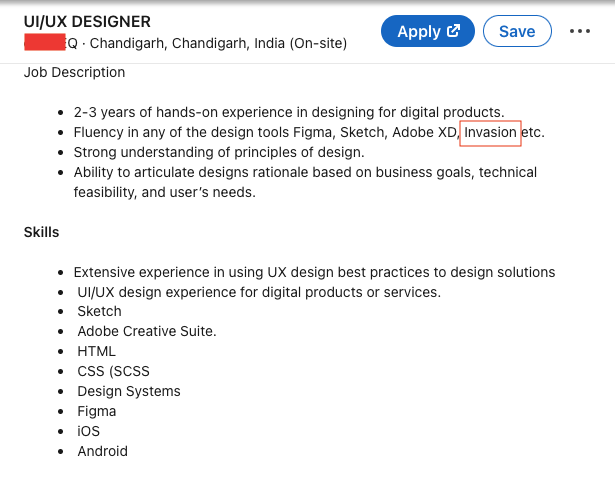
That is not a typo.
That is a signal about what the organisation actually pays attention to.
Org: That's embarrassing but hardly catastrophic.
Design: The catastrophic things are made of these. A crack in the beam is not catastrophic but the fall of a beam on someone is catastrophic.
In your language:
A teenager who reaches for her phone at eleven at night is not a catastrophic event.
It is the sum of ten thousand small decisions — each one made by someone who was moving fast, who had a deadline, who was measuring the wrong thing, who never sat in the room where the consequence lived.
The Microsoft login error.

This error message does not break anyone’s life.
Or, the Microsoft Whiteboard metadata.
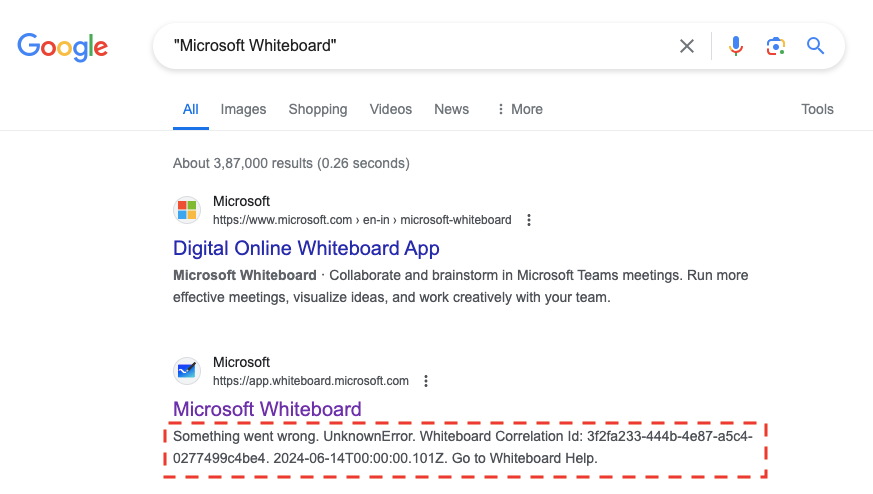
But the experiences accumulate.
In a person's day, they accumulate into the feeling that technology was made for someone else. That the people who built these things were not thinking about them.
That they are, in the language of design, an edge case. No person should feel like an edge case in their own life.
Org: That's what practitioners are supposed to prevent.
Design: Yes. And they try.
But you have built an environment where the practitioner who sees the red text writes it in a ticket. The ticket goes into a backlog. The backlog is triaged against a roadmap. The roadmap serves a metric. The metric serves a target.
And the red text stays red.
Not because nobody cared.
Because the system made caring optional and shipping mandatory.
The practitioner is not the failure.
The environment is.
And the environment is what you designed.
Org: We run ethics reviews. We have responsible design guidelines.
Design: They govern the decisions you have already decided to make. They do not ask the right questions.
Org: What is the right question?
Design: Should we build this at all?
Org: (pause)
That's not a practical question at our scale. We are a technology company, we cannot solve civilizational problems.
Design: No. But you can stop pretending that you are not contributing to them.
Org: So you mean, we should stop building?
Design: You start remembering.
There was a museum director who described what good cultural institutions do as building a bridge of relevance—from the past, through the present, into the future. Not to preserve things. To keep them alive enough to teach. (Link)
Org: That's a museum. We are a technology company.
Design: You are an organisation that shapes how millions of people experience reality. So was every cathedral ever built. So was every library. So was every public square.
The question is whether you know that. Whether you feel the weight of it.
Org: Of course we feel it. We have entire teams dedicated to…
Design: Tell me the name of the person most responsible for the algorithm that surfaces content to lonely teenagers at night.
Org: That's... that would be distributed across several teams.
Design: No one is responsible.
Org: The system…
Design: The system has no face. That's the point. You built a system without a face so that no one would have to look at what it does.
That is a design decision.
Org: You are accusing us of being deliberately irresponsible.
Design: No, I am accusing you of something worse.
Being accidentally irresponsible at scale. Systemically producing outcomes nobody owns. Senge called it systems ignorance — the gap between the interdependence we've created and the awareness we've developed to understand it. (Link)
You've created enormous interdependence. Your awareness has not kept pace.
Org: How do you close that gap?
Design: You restructure.
Not the product, but the organisation itself.
Org: How?
Design: Right now, your hierarchy protects certain questions from ever reaching the people with the power to act on them. The designer raises the issue in a ticket. The document goes into a review. The review produces a recommendation. The recommendation competes with a quarterly target. The target wins.
It happens.
Not because anyone decided the target matters more than the teenager. Because the system was designed to make the target visible and the teenager invisible.
Org: How do you make the teenager visible?
Design: You change what you measure. You change who speaks in what room. You change which questions are allowed to interrupt a roadmap. You reward them for their curiosity and not for the containers designed.
You build an organisation where the person who sees harm has a shorter path to the person who can stop it than the person who sees an opportunity has to the person who can fund it.
Right now that path is backwards.
Org: But it sounds like slowing down. We operate in a competitive landscape.
Design: Marc Baumgartner wrote about this. He called it peak design—the moment when the world starts doing less with design, not more. (Link)
You know what brought it on?
Org: My guess is AI but I am not sure.
Design: Design let itself be infantilised. It was renamed Design Thinking and sold to boardrooms by people and most of them had never designed anything.
And in the process, the question design was actually supposed to ask — what kind of world does this make possible — was replaced by: how do we make this process more efficient?
The same thing is happening in your organisation right now.
You have design teams. They are not asking the design question. They are asking the product question. Which is only the business question in a different font.
Org: The design question...?
Design: What kind of world does this make possible? And, for whom?
Org: Those are very broad questions for a product roadmap.
Design: I want to show you something. Come with me.
They walk towards a local museum, without speaking. They saw the city—the billboards, a school letting out, a man waiting at a bus stop with a phone in his hand, a flower seller.
They stop in front of the museum, a small museum. The kind that does not make international lists.
Inside: objects. Ordinary objects. A child's shoe. A letter written in a language the original writer's grandchildren no longer speak. A photograph of a street corner that no longer exists, from a time when the people in it were alive and did not know they were being preserved.
Then enter.
Design: Look at the shoe.
Org: It's a child's shoe. Small, and very old.
Design: Someone made that. Someone thought about the way a child runs, what a child needs to feel held by the ground.
They had a child in front of them.
And they made something that said: I thought about you.
Org: (quietly)
It's beautiful.
Design: Now look at your last product release. Find the thing in it that says: I thought about you.
Not the feature. Not the new onboarding flow.
The moment—if there is one—where a human being felt, for even a second, that the person who built this had them in mind.
Org: (long pause)
I'm not sure there is one.
Design: That's not because your people don't care.
It's because you've built an organisation that processes humans rather than thinks about them. A culture that optimises for human behaviour rather than considering their dignity.
This shoe is three hundred years old.
The child who wore it is long gone.
But the care that made it—that is still here. Still, somehow, alive.
What will remain in your product that people could see in one hundred years? Or even in fifty years?
What care will someone be able to read or see in what you made?
Org: (no answer)
Design: That question is not rhetorical.
It is the oldest design question there is.
And almost no one in your industry is asking about it.
They stand for a while longer.
A small girl stops in front of the shoe. Then she looks up at her teacher and asks—”Did someone love this child?”
The teacher says: “Yes. Someone did.”
The girl nods, as if this is the answer she needed, and moves on.
Design: That question.
That is the question your product should be able to answer.
Not: Did we grow? Not: Did we retain? Not: Did we expand?
Did someone love the person this was made for?
Org: (very quietly)
I do not know how to build that into a roadmap.
Design: You do not build it into a roadmap.
You build it into the culture. Into the sentiment. Into what you are. Find the care, and the love. Build the care culture.
Into the people you hire, and the questions you let them ask, and the kind of answers you let interrupt a meeting. (Jony Ive captured this sentiment in their interview with Patrick Collison https://www.youtube.com/watch?v=wLb9g_8r-mE)
The same museum director said that the role of a good cultural institution is not just to create a space for encounter—but to actively moderate the questions a society is afraid to ask itself.
You have three million people inside your product.
You are, whether you accept it or not, a cultural institution.
The question is whether you will moderate those questions deliberately — or let the algorithm decide which questions are never asked at all.
Design: Let me show you something else.
Org: (waits)
Design: Let’s walk to the metro station. Just walk.
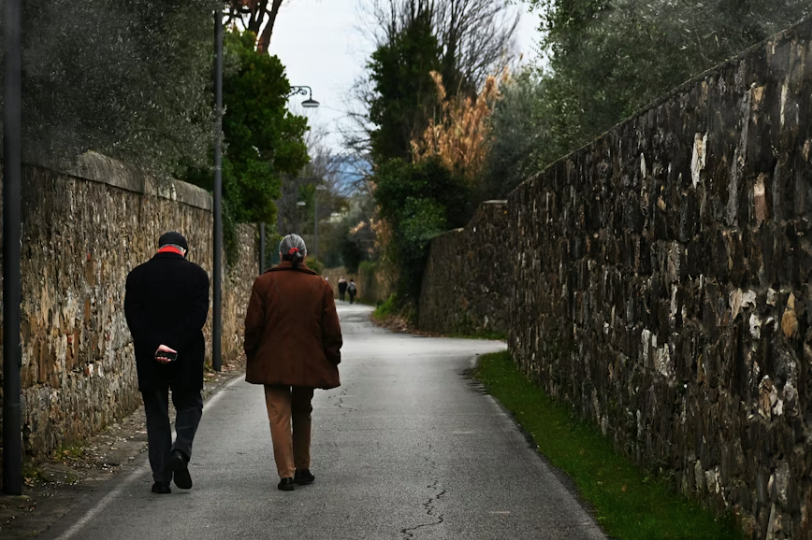
(pause)
Design: What you see.
Org: I see... signs. A coffee shop. People walking. A crossing.
Design: Which way does the crossing sign point?
Org: Both directions. Left and right.
Design: And you know which way to go?
Org: Yes, because — oh.
Design: Because you already knew where you were going. But the person who didn't know this city, arriving for the first time, the immigrant employee's mother visiting from another country—she is standing at the same sign.
What does she feel?
Org: (quietly)
That nobody thought about her.
Design: There's a metro system. Seven hundred thousand people move through it every day. A team sat down before designing a single sign and asked one question: what does a person need to know, and exactly when do they need to know it?
Not: What looks consistent. Not: What matches the brand.
What question is this person carrying right now, at this exact moment, and how do we answer it?
They mapped every question. In sequence. From the street to the platform to the train to the exit and back into the city.
Seven hundred thousand people a day. Most of them never notice the signs.
Org: Because they just... move.
Design: Because when infrastructure works, it disappears. You don't notice it until it fails you.
Your product’s payments’ experience failed someone. It failed many times. The Microsoft sign in form failed many.
But the failure wasn't about a field. It was about a question nobody stopped to ask.
What does this person need, right now, at this exact moment?
Org: (slowly)
We've been building features. We haven't been answering questions.
Design: A researcher, Shannon Mattern spent years studying what happens when cities start thinking of themselves as computers—optimizing for dashboards, for data, for efficiency. She found that when you reduce a city to what can be measured, you don't make it smarter. (LINK)
You make it blind.
Blind to the cattle path that became a street because people needed to get somewhere. Blind to the doorway width that fits someone carrying something. Blind to the curb cut designed for a wheelchair, used by everyone but noticed by no one.
The city's intelligence was never in the data. It was in the accumulated answers to one question: who needs to move through here, and what do they carry?
Tell me—When did purpose last override a revenue decision in your organization?
Org: (no answer)
Design: That silence is the answer.
Not because your people don't care. Because the structure makes care optional and profit mandatory.
You designed this organisation.
You can design a different one.
Org: What would that look like?
Design: Like a museum that considers itself a fourth place — not just a space where people encounter things, but a space that actively moderates the questions a society is afraid to ask itself. That takes sides. Not politically, but epistemologically.
That says: here is what we know, here is what we owe to the past, here is what the future needs from us.
As I said, you are a cultural institution, whether you want to be or not.
Every product that reaches millions of people becomes, in time, part of the architecture of how those people understand the world. The question is whether you designed that architecture consciously, or whether you let the quarterly cycle design it for you.
Org: I don't know if I know how to think at that scale.
Design: (gently)
That's the most honest thing you've said.
Org: It's overwhelming.
Design: Senge said the same thing differently. He said the problem isn't that the challenges are too large.
The problem is that we've disconnected the act of making decisions from the act of experiencing their consequences.
The person who decides to optimize the notification algorithm never sits like the teenager sits at eleven at night. The person who approves the cancellation flow never watches someone who can't afford the subscription try to leave.
There are engineers and designers in the product teams and in the agencies who have never seen their product’s landing page—not even one. I cannot find a word for calling it “super ridiculous”. (Related LinkedIn post)
Org: You're describing every large organisation.
Design: Yes.
That's what makes it a systems problem.
And that's exactly why it requires a systems answer.
Not better guidelines.
Different proximity.
Org: Proximity to what?
Design: To consequences.
Org: That would change every meeting we have.
Design: Yes.
Org: It would slow us down.
Design: It would change what you mean by speed.
Right now, speed means how fast you can ship.
What if speed meant how quickly you could tell whether what you shipped was good?
Org: (after a long pause)
investors would accept that framing.
Design: Your investors accepted a framing in which a company's value is measured by its ability to extract attention from human beings and sell it.
That framing has consequences.
You can negotiate with it. Most people never question it.
But it is, like every other framing, a design decision.
Someone made it. Someone can unmake it.
Org: That someone would have to be willing to lose a lot.
Design: Henkel asked himself a question once.
He said: I would love to meet the dead warrior who was buried with the stone axe we excavated — and ask him whether he considers the methods of archaeology necessary and justifiable.
He was asking: Does the act of understanding justify the intrusion?
I'm asking you a version of the same question.
Does the act of growing justify what you extract to do it?
Org: (very quietly)
I don't know anymore.
Design: Good.
That not-knowing is the first honest thing you've had to work with in years.
Don't optimize it away.
Org: What do I do with it?
Design: Sit with it long enough to feel what it costs.
Then go back into the organisation and find one room—one meeting, one role, one decision—where that not-knowing is allowed to change the outcome.
Not the whole organisation. Not yet.
One room.
Org: And if the organisation resists?
Design: It will.
Systems always protect themselves.
But systems also change through the behaviour of the people inside them. Not through their beliefs—through their behaviour. What they do, not what they think.
Senge said it.
You don't change a system by announcing new values. You change it by building one environment where the new behaviour is possible.
Then another. Then another.
Until the behaviour outlasts the resistance.
Org: That could take years.
Design: The cathedral builders of Europe worked on structures they knew they would never see completed.
They designed for a future they would not live in.
That is what it looks like to take consequence seriously.
Org: (quietly)
I'm not sure we know how to build for a future we will not even see.
Design: You used to.
Before the quarterly cycle made everything visible, everything measurable, everything now—you used to plant trees you wouldn't sit under.
I remember.
I was there.
I have been the infrastructure.
Org: How do I remember that?
Design: By changing what you call success.
Not what you put in the press release.
What you allow yourself to feel proud of, at the end of a day, in private.
Is it the metric that moved?
Org: That's a much harder thing to feel proud of.
Design: Yes.
Pride in restraint is one of the most difficult things I've ever been asked to help design.
Most organisations never ask me to.
Org: I'm asking.
Design: (a long pause)
Then we have somewhere to begin.
A sound.
Of the phone ringing on a bedside table.
Org opens their eyes.
The ceiling. A bedroom. Morning light in the corners somewhere.
A dream.
Org have just seen a dream.
But the girl is still there—the one who stopped in front of the shoe and asked: did someone love this child?
That question is not in the dream anymore.
It is in the room.
Org sits up slowly.
Does not reach for the phone.
Does not open the emails.
Gets up.
Walks to the mirror.
And stops.
Slowly opens a notepad.
Writes a single question at the top of an empty page:
What does this make possible, and for whom, for how long?
Org closes it, and goes to work.
Org opens the laptop. Thinks about something, and writes a prompt to find what they should do next.
But they do not send the message. It was there like an email draft. There is no conversation because the intelligence could not answer the unsent questions.
The org signs out. Not to find the answers but to design the answers.
About the author
Vinish Garg is searching for the intersections in our work—intersection of sense, meaning, and purpose that build an organization's capacity to design itself, and to design design. Vinish woks with organizations for their product strategy, onboarding and UX, and product content design strategy—often on the intersection of system thinking, building capacity, and establishing systems for the organization’s goals.
Author links:


Discussion